At a session during "WordCamp Asia 2026," the future development policy for Contact Form 7 was announced, which has been creating quite a stir lately.
Seeing the phrase "end of development" alone likely made many people feel uneasy, wondering, "Does this mean I can't use it anymore?"
In reality, for those involved in building and operating WordPress sites, form plugins are an essential component. Any sudden change in policy is naturally a cause for concern.
In this article, we will organize the details of the announcement and explain from a practical perspective whether it is safe to continue using Contact Form 7 in the future.
The True Meaning of "End of Development"
First, it is important to clarify exactly what is meant by "end of development."
This announcement does not mean that all support is ending.
Specifically, the policy is as follows:
- No new features will be added moving forward.
- Bug fixes and security updates will continue.
In other words, it is safe to assume that only the "feature addition phase" has concluded, and the plugin will continue to be maintained.
Furthermore, this announcement is not a simple termination, but rather a step toward transitioning to a new design philosophy.
Why It Is Perfectly Fine to Continue Using It
1. Contact Form 7 is Already Highly Mature
Contact Form 7 has a long-standing track record and already possesses sufficient functionality for standard inquiry forms.
Since it was never the type of plugin to have features added frequently anyway, the impact of halting new development is relatively minimal.
2. Security Support Will Persist
The announcement explicitly stated that bug fixes and security updates will continue.
Security is the most critical factor in WordPress maintenance.
As long as vulnerability patches are maintained, there is no significant practical risk.
3. Built-in reCAPTCHA Support
One of Contact Form 7's major strengths is its native support for reCAPTCHA.
The ability to integrate spam protection as a standard feature without relying on additional plugins makes it superior in terms of operational simplicity.
This remains a significant advantage when compared to other form plugins.
However, this announcement is not just about "staying the course"; it also serves as an opportunity to consider the future direction of form design.
Practical Judgment: Is There a Need to Switch Right Away?
In conclusion, there is no urgent need to switch from Contact Form 7 at this time.
You can safely continue using it, especially in the following cases:
- You are using it as a general inquiry form.
- It is operating stably on an existing site.
- No special or complex customizations are required.
On the other hand, it might be a good time to reconsider your options if:
- You are building complex business forms.
- You want to improve UI/UX.
- You need to add unique, custom functionalities.
Differences from MW WP Form
As mentioned in a previous article, the situations for MW WP Form and Contact Form 7 are slightly different.
MW WP Form has currently ceased new development, and it has entered a phase where its long-term viability needs careful consideration.
Additionally, reCAPTCHA is not integrated as a standard feature in MW WP Form, which leaves some operational challenges.
In contrast, Contact Form 7 is:
- Continuing to receive security support.
- Equipped with standard spam protection.
- Backed by an enormous user base and track record.
Because of these points, it can be considered to be in a position where it can still be used with peace of mind.
Conclusion
While many may have felt anxious about the term "end of development," looking at the facts shows that no immediate problems are likely to arise.
Since Contact Form 7 will continue to receive security updates and bug fixes, staying with it on existing sites remains a perfectly realistic choice.
At the same time, this announcement is not just a "termination" but the start of a transition toward the next era.
Mr. Miyoshi pointed out that with the rise of "decoupled architectures" (such as Headless CMS) in recent web development, traditional form mechanisms are becoming less compatible with modern standards.
To address this, Contact Form 7 has already introduced a mechanism called "Schema-Woven Validation (SWV)," an attempt to make validation work even in environments where the frontend and backend are separated.
Details about SWV are explained in depth in the official documentation, so please refer to it if you are interested.
Schema-Woven Validation (Official Documentation)
Moving forward, a next-generation project that evolves this concept further is being envisioned as "Contactable.io."
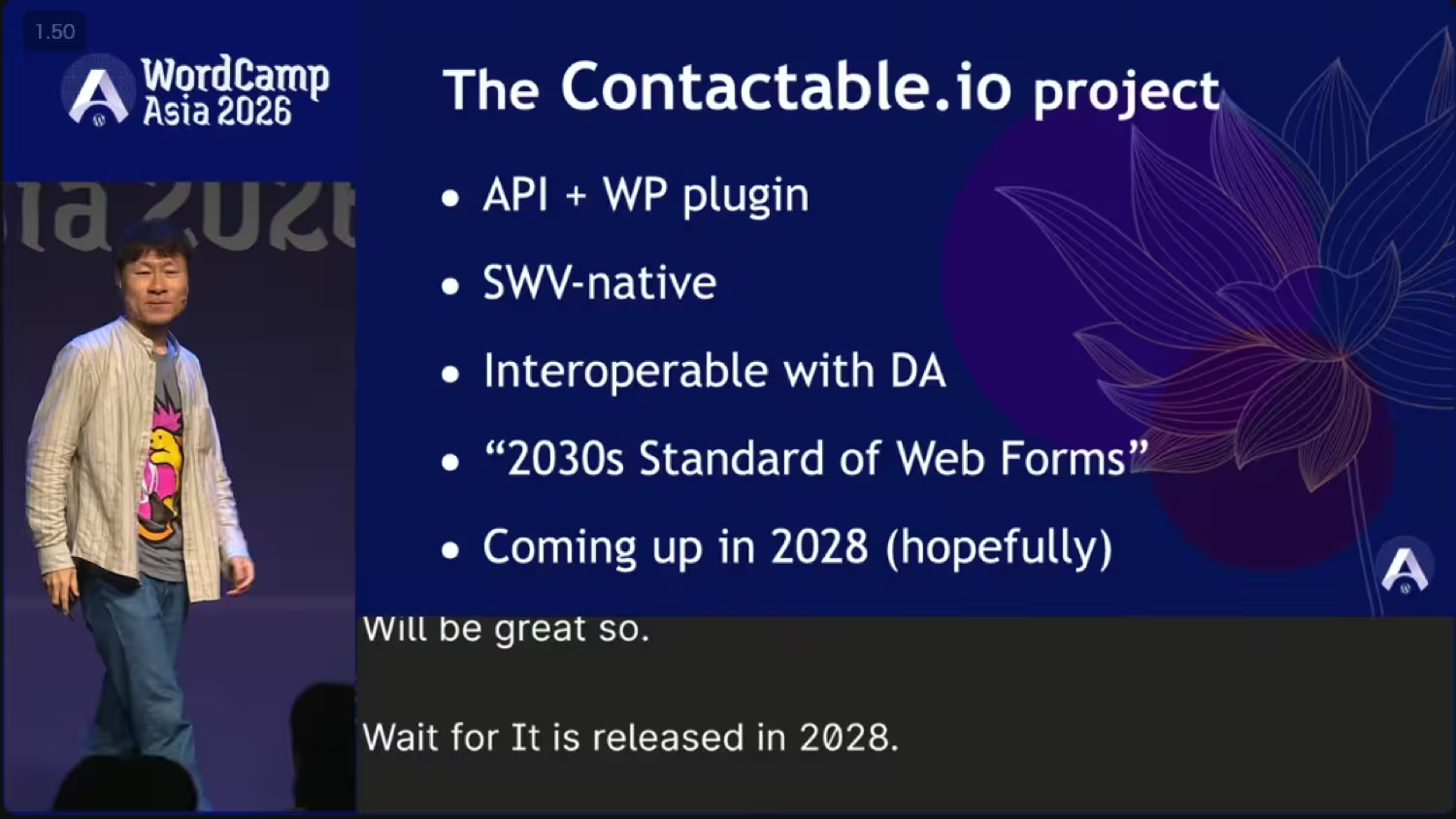
From the presentation slides at WordCamp Asia 2026
This new project is intended to be built on an API-first approach, designed for the web standards of the 2030s, with a target release around 2028.
In other words, this announcement can be seen as "a decision to transition to a new design rather than forcing the life of an outdated system."
While there is a bit of sadness seeing such a long-standing plugin reach this stage, I felt it was a very sincere decision that prioritizes technical consistency.
There is no need to change anything immediately, but being aware of these trends will serve as a helpful reference when considering future form designs.
WordPressサイトをお持ちの方へ
貴社サイトのURLを入れるだけ。
専用AIチャットの体験ページが、数分でできます。
公開ページを自動で読み込み、出典リンク付きで答えるAIチャットを無料で作成。書かれていないことは「記載がありません」と正直に答えます。入力はURLとメールだけ、売り込みはしません。
WordPress専用 AIチャットボット「Edel AI Hybrid Chat」(合同会社 Edel Hearts)
この記事を書いた人

矢部 敦合同会社Edel Hearts 代表
WordPress専門の開発会社を経営。プラグイン開発・カスタマイズ・保守を専門とし、18時間におよぶUdemyのWordPress講座を開講。出典付きで回答するAIチャットボット「Edel AI Hybrid Chat」開発者。著書『WordPress はじめての最小プラグイン』(Kindle)。本ブログの記事は、実際の開発・運用で得た一次情報をもとに執筆しています。会社情報はこちら